


At-a-Glance:
- Your swollen mole may be harmless (trauma or irritation), or it may be a sign of a serious skin condition like melanoma.
- If you notice any one of these (asymmetry, irregular borders, changes in colour, growth, or bleeding ) in your moles, that’s a red flag.
- Your mole should be checked visually or undergo a biopsy if needed.
- Early detection is important, so don’t delay it. You may need a mole mapping to track the changes of your mole.
What is a mole?
A mole is a common type of skin growth. Normal moles appear as small, flat, and round with a dark brown colour. Almost every individual has it, and it may appear at birth or later in life.
Moles are usually harmless. But in rare cases, it can be malignant. That’s why it is important that you know everything about moles and when you should be worried.
Characteristics of Moles
- Their usual colour is brown, tan, or black.
- Shapes are round or oval.
- Some are flat and some can be raised.
- They usually appear during childhood or teenage years.
- Colour may darken because of sun exposure, pregnancy, or ageing.
Normal vs. Abnormal Moles
Normal moles look uniform. It has smooth edges, colours are the same, and size does not change.
Abnormal moles tend to:
- Change their colour and texture
- Grow bigger
- Itch or bleed
- Become swollen or painful
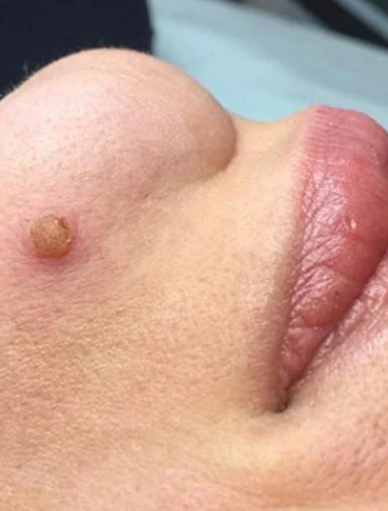
What Does a Swollen Mole Look Like?
If you have a swollen mole it can be easy to differentiate with some of the regular moles you have. Here’s what they look like to guide you with:
- It may look raised or puffy
- There’s a sore or itchy feeling
- The edges are red or inflamed
- It looks like a pimple or spot
- It ooze or crust over occasionally
Possible Causes of a Swollen Mole
There are many factors why your mole becomes swollen. Some can be considered as non-cancerous, while some need you to monitor them or have it checked by your physician.
Inflammation & Irritation
You should not be worried about these factors because it usually happens in your everyday life and not the sign that your mole is cancerous.
- When there’s friction or when your clothing, jewellery, or even your shaving tools rub against your mole.
- When an insect bites you or you accidentally scratch your mole.
- You have bacterial or fungal infection on your skin.
- It can also affect the pigment and texture of your skin if you are experiencing hormonal changes.
If you experience these, apply over-the-counter topical medications (for insect bites or skin infection), some of these go away on their own after a few days. If your symptoms persist, consult your doctor.
Benign Lesions
You need to know how to differentiate a swollen mole from benign lumps because sometimes, a swollen mole that you think is not a mole at all can be a benign lump, which may include the following:
- Epidermoid cyst: It looks like firm bumps under your skin that are small and round.
- Lipomas: Soft, fatty growths.
- Dermatofibromas: A firm nodule that appears when you have a minor injury. (Your dermatologist may distinguish this with the use of imaging or by examination).
Effective & professional doctor-led Swollen Mole Like a Spot at our central London clinic
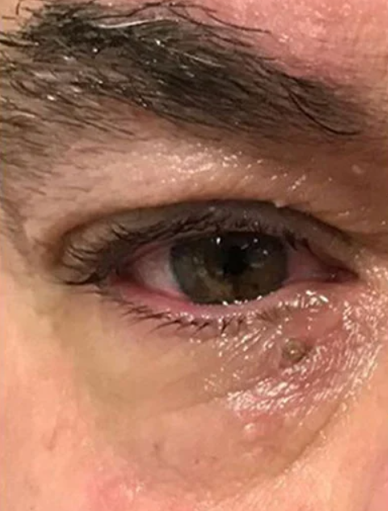
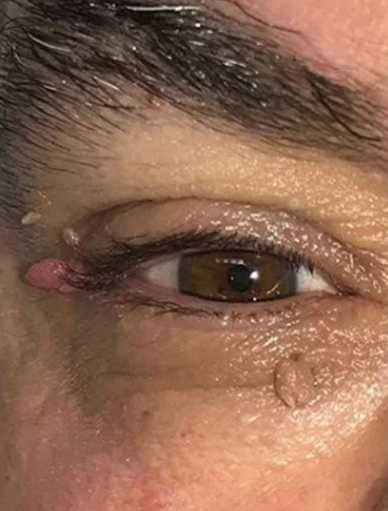
Verified Before & After
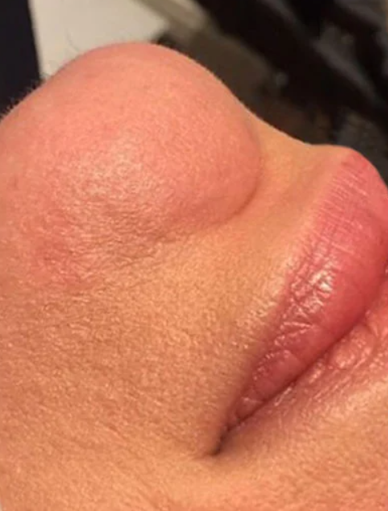
Verified Before & After
Skin Cancer Symptoms
Check if your swollen mole also changes its shape, size, or texture suddenly because it may be a sign that it is cancerous. Here’s how you spot them using the ABCDE rule:
| Sign | Meaning | Why it matters |
| A-Assymetry | The other half looks different from the other. | Because the growth pattern is irregular |
| B-Boarder | Edges are uneven, blurred, or jagged. | It’s the usual symptoms of melanoma |
| C-Colour | Multiple shades (brown, black, red, blue) | Uneven pigment means warning. |
| D-Diameter | Larger than 6mm (pencil erasers) | Bigger sizing has a higher chance of cancer |
| E-Evolving | Changes its size, shape, or feel. | Critical warning sign. |
If you notice one of these signs on your mole, you need to book a consultation right away.
Other Conditions That Mimic a Swollen Mole
Your skin may have lumps or marks that’s not actually a mole:
- Seborrheic Keratosis: Brown patches that are waxy and look like warts.
- Cherry Angiomas: Spots that are dome-shaped and have a bright red colour.
- Dermatitis:Irritated skin that is swollen or red.
If you are confused if it;s mole or not, have it checked by a professional. They can assess and help know the difference.
Importance of a Dermatology Consultation
A dermatologist needs to see your mole closely and may use dermatoscopy to confirm if your mole is harmless or not. A consultation with them can help determine cancer at an early stage, which can still be treatable.
Signs that Needs Immediate Attention
Don’t ignore if your mole has the following signs:
- It raised suddenly and grew bigger.
- Has fluids coming out, with bleeding, and scabbing.
- You feel pain, itchiness, and tenderness.
- The colour looks uneven and there’s a new dark spot.
- It looks different from your other moles.
How a Skin Examination Works
A skin examination is very important because sometimes the problem can’t be determined by just looking at your moles. It will need proper assessment to tell its malignancy.
- Your doctor will check your mole if there’s an irregularity on its border or colour.
- Will view the surface beneath using a dermatoscope
- Take a picture of your mole to compare them on your next visit.
- If your mole looks suspicious, they may recommend a biopsy.
The Role of Imaging and Biopsy
A biopsy is the most reliable diagnosis. A sample of small tissues will be removed from you then will bring it to the laboratory for thorough analysis. Digital imaging may help to monitor the changes of your mole.
How Mole Mapping Helps Monitor Changes Overtime
A mole mapping is a photograph of your body to document every detail of your moles or to see if there are changes over time. It helps catch the cancer sign as early as possible.
It is usually apply to those people with:
- Many moles
- Fair skin
- Family history of melanoma
- Abnormal biopsies previously
What Happen After Suspicious Mole Removal or Biopsy
Your dermatologist may remove your suspicious moles for analysis. The process of removing them is simple and may leave you with minimal scarring. Typically, you will know the results within a week or two. It can tell whether your mole is benign, precancerous, or cancerous.
Your doctor may start planning your treatment if needed.
Conclusion & Regular Mole Health Checks
A swollen mole like a spot may be because of some irritations and is non-cancerous, but it can also be a sign that your skin is experiencing a skin condition called melanoma.
It is best that you know how to spot those warning signs using the ABCDE rule, and seek professional help so it can be detected and treated as early as possible. You should make mole checking and mole mapping a part of your yearly routine.
FAQS
- Can irritation alone cause a mole to swell like a spot?
Yes, if your mole is irritated because of friction, scratching, or shaving it can make it inflamed or swollen. But if the swelling takes longer to subside, you need to see your doctor for assessment.
- Which warning signs in a mole should prompt immediate attention?
If you notice your mole has signs from the ABCDE rule, don’t ignore it and see your dermatologist.
- How often should I undergo mole mapping?
It is recommended that your skin be checked yearly. But if you are at high risk, you should be checked every 6 months.
- Is biopsy often necessary for a swollen mole?
A biopsy is needed when your mole looks suspicious, but you don’t always need it.
- Can benign mole swelling resolve on its own?
Yes, if the swelling of your moles is because of irritations or minor skin infections. It usually goes away after a few days when your skin is healed and the friction stops.
Reserve a mole appointment
One of our experts will be more than happy to answer any questions you have.
Book Appointment

Max Williams
★★★★★
Very helpful and covered any concerns I had in detail
14th August 2026

Lauren Super
★★★★★
Very good facial with Rose, she was very helpful.
14th August 2026

Jessica Barden
★★★★★
Absolutely amazing care and advice could not recommend enough. Have been coming for years
14th August 2026